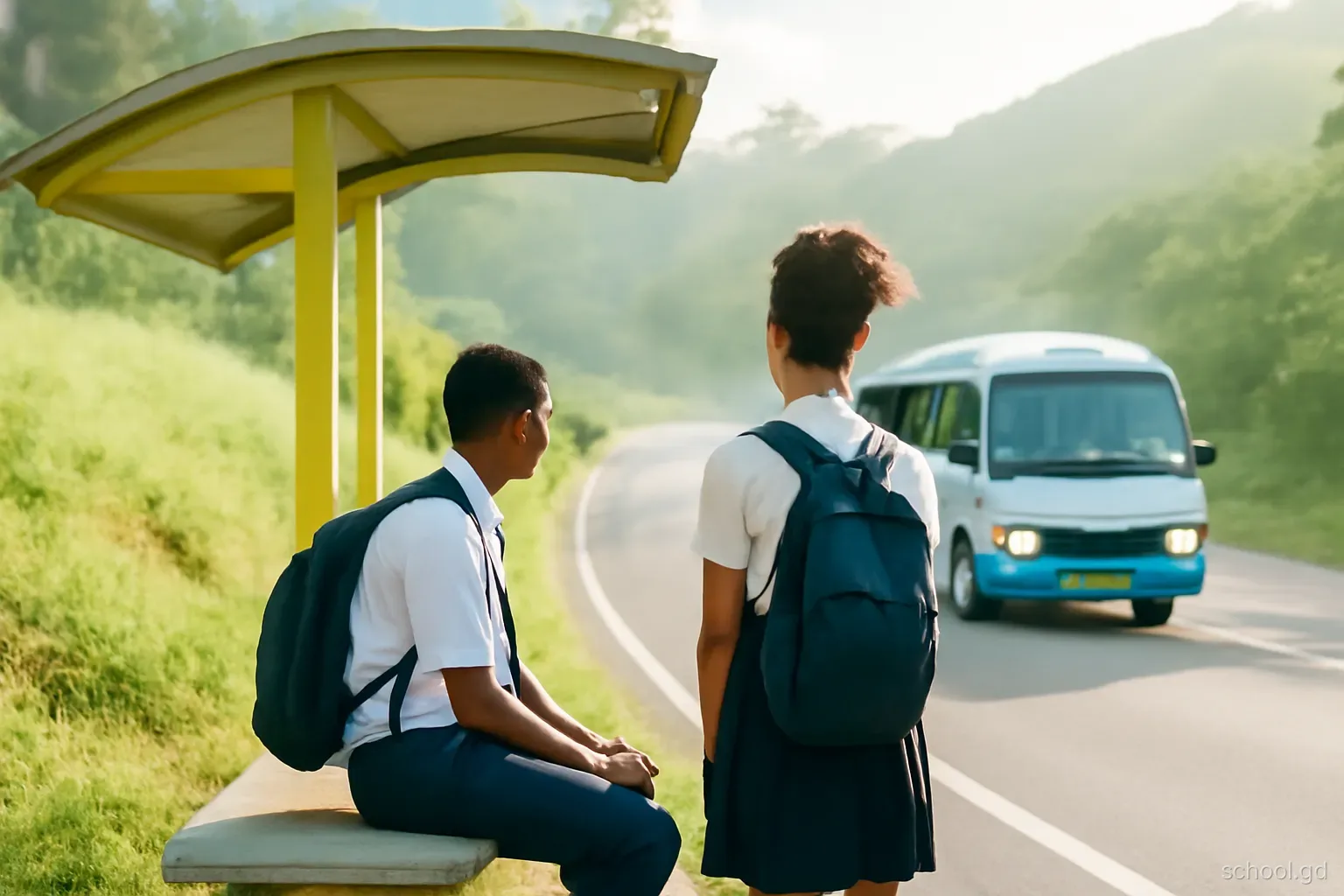
For most Grenadian secondary students, the school day starts at the roadside. Grenada has no large fleet of yellow school buses; instead, teenagers get to school on the privately operated minibuses known as route buses, on foot, in family cars or on the small number of school transport services that operate in some districts. A twelve-year-old in a rural village may be flagging down a bus before 7am and changing in town, while a student who lives near a school simply walks.
The commute affects more than punctuality. It shapes how tired students are, how much the family spends each week and, for parents, how much they worry. This guide looks at how school travel actually works in Grenada, what the main risks are and how families plan around rain, traffic and long distances. Fares, routes and any transport assistance change, so confirm the current arrangements locally.
How route buses carry the school run
Route buses are privately owned minibuses that run on numbered routes, most of them starting from the bus terminus in St George's and fanning out across the island. They are licensed and regulated, fares are set by the authorities according to distance, and drivers stop wherever passengers wave them down along the route. For schoolchildren this flexible system is both convenient and demanding: buses are frequent on the main roads at peak times, but they fill quickly and do not wait.
In the morning, buses heading into St George's and Grenville are packed with workers and students together. Students who live near the start of a route find it easy to get a seat; those further along may watch several full buses pass. Many families respond by sending children out earlier than strictly necessary, which is a sensible habit in the first weeks of Form 1.
Students are expected to pay their fare. Arrangements for student fares have varied over time, so check the current rate with drivers or the school, and give your child coins or small notes so they are not waiting for change.
Other ways students travel
Walking. Students who live within a couple of kilometres of school often walk, sometimes in groups. Many Grenadian roads have no pavement and run through blind bends, so walkers need to face oncoming traffic, keep to the edge and avoid walking several abreast.
School transport services. In some rural districts, school transport services carry students who would otherwise face long or difficult journeys. Coverage, eligibility and timetables are set locally and can change, so ask your school or the Ministry of Education's district office whether a service runs in your area.
Family cars and lifts. Many parents drop children on the way to work. This works well until a parent's schedule changes, so keep a back-up plan. Car-sharing with neighbours is common and helps with the congestion around schools.
Taxis. Taxis are mainly used for occasional journeys, late finishes or emergencies. Agree the fare before setting off.
Carriacou. On Carriacou, distances are shorter and traffic lighter, but buses are fewer. Families there often rely on walking, lifts and community arrangements.
Planning around rain, traffic and long days
Grenada's rainy season, roughly June to December, overlaps with most of the first school term. Heavy downpours slow traffic, flood low points on the roads and occasionally cause landslides on hill roads. Students caught in a storm at a roadside without shelter arrive at school soaked. A light rain jacket or a compact umbrella, and a plastic bag inside the school bag to keep books dry, are worth more than many items on the booklist.
Traffic around St George's, the Grand Anse area and Grenville can add twenty or thirty minutes to a journey at peak times. When students run late, it is usually because of the bus, not the alarm clock, and most schools understand this within reason. Persistent lateness still counts, though, so a slightly earlier start is better than a daily dash.
Long commutes make for long days. A student who leaves home at 6.30am and gets back at 4.30pm after a club or extra lesson has little energy left for homework. If the journey is exhausting your child, raise it with the school; sometimes a quiet place to study before or after classes helps.
Safety rules worth agreeing with your child
Most school journeys in Grenada pass without incident, but a few clear rules reduce the risks that do exist:
- Wait for buses at recognised stopping points, standing well back from the edge of the road.
- Board and leave buses only when they have stopped, and never cross the road in front of a bus that has just pulled in.
- If a bus is driving dangerously or the music and behaviour make your child uncomfortable, it is fine to let it pass and wait for the next one.
- Keep phones and money out of sight while waiting, and avoid travelling alone along very isolated stretches late in the day.
- Know the route well enough to recognise a wrong turn, and have money for the fare home even after spending on lunch.
- Tell a parent if anyone, driver or passenger, behaves in a way that is inappropriate. Parents can report concerns to the police or the transport authorities; in an emergency, call 911.
- Stay with friends where possible, especially after evening events or sports practice.
Adjusting the rules as students grow
What suits a Form 1 student rarely suits a Form 4 student. In the first term of secondary school, many parents arrange for a younger child to travel with an older sibling, a cousin or a neighbour's child at the same school. Others drive the child for the first weeks and then shift to the bus once the routine is settled. There is no fixed age at which a child is ready; it depends on the route, the child and whether there are friends making the same journey.
By the middle forms, most students travel independently and start to stay later for clubs, sports and extra lessons. This is the point at which rules about evening travel matter more than morning ones. Buses become less frequent after the evening peak on some rural routes, and the last convenient bus home may leave earlier than a student expects.
Older students in Forms 4 and 5 are often travelling to after-school study groups, examination centres and weekend events in other parishes. A clear agreement about where they are going, how they will get back and when they will check in gives them freedom while keeping parents informed. Review those agreements each year rather than relying on rules made when the child was eleven.
It also helps to share the plan with the school. Form teachers who know that a student relies on a particular bus, or travels with a sibling, can make sense of lateness on a bad day and are more likely to raise a concern early if something about the journey seems to be troubling the child.
Mistakes families make with the school commute
Judging distance by the map. A school eight kilometres away on a direct route can be easier than one four kilometres away that requires a change of bus in town. Test the actual journey.
Ignoring the return trip. Afternoon buses can be harder to catch than morning ones, especially when several schools finish at once. Plan the journey home too.
Assuming every child is ready on day one. Some eleven-year-olds handle the bus confidently straight away; others need a few weeks of company. Let your child build up to travelling alone.
No plan for disruption. Roadworks, accidents, storms and the occasional bus strike happen. Agree where your child should go and whom they should contact if they cannot get home as normal.
Underestimating the cost. Daily fares for one child add up over a school year, and more for two or three. Budget for them alongside uniforms and books.
Frequently asked questions
Are there school buses in Grenada?
There is no large dedicated school bus network. Most secondary students use the privately operated route buses, walk or get lifts. Some rural districts have school transport services, so ask your school or the Ministry of Education's district office whether one runs in your area.
How much do students pay on route buses?
Fares are set by distance and arrangements for students have varied over time. Ask the bus drivers on your route or the school for the current fare, and give your child small change so they are not held up waiting for change.
What time should students leave home for school?
Most schools start around 8am. Students on busy routes into St George's or Grenville often need to be at the roadside well before 7am to be sure of a seat. Practise the journey at the real time before term starts.
Is it safe for Grenadian teenagers to ride route buses alone?
Thousands of students do so every day, and most journeys are uneventful. Teach basic rules about waiting safely, keeping valuables out of sight and letting an unsuitable bus pass. Younger students often travel with siblings or friends for the first few weeks.
What should students do if heavy rain closes roads?
They should stay somewhere safe and contact a parent rather than trying to walk through flood water or past landslides. On days of severe weather warnings, listen for announcements from the Ministry of Education about school closures.