
For a Grenadian family, Grade 6 is the year the Caribbean Primary Exit Assessment becomes the topic at every dinner table. The CPEA, developed by the Caribbean Examinations Council, replaced the old Common Entrance examination in Grenada and several other Eastern Caribbean countries over the past decade or so. It marks the end of primary school, gives a picture of each child's learning across core subjects, and its results are used in placing children in secondary school.
Many parents sat Common Entrance themselves and assume the CPEA is the same test under a new name. It is not. The biggest change is that part of the assessment is done in school, over time, through coursework, rather than everything riding on a single morning of papers. This explainer sets out how it is structured, how results are used and what parents commonly misunderstand. Details can change from year to year, so confirm the current arrangements with your child's school and the Ministry of Education.
From Common Entrance to CPEA
For generations, children across the English-speaking Caribbean sat a Common Entrance examination at the end of primary school. It was a high-stakes, one-shot test, largely in English and mathematics, and it decided which secondary school a child would attend at a time when secondary places were scarce. Grenadian adults often remember it vividly, along with the extra lessons, the waiting for results and the lists published in newspapers.
As Grenada moved towards universal secondary education, so that every child completing primary school has a secondary place, the purpose of an end-of-primary assessment shifted. The aim was no longer just to select a few students for limited places, but to measure what all children had learned and to support decisions about placement and support.
CXC introduced the CPEA to meet that need with a common regional framework. Grenada adopted it in place of Common Entrance, and it is now the standard exit assessment for Grade 6 students in public and government-assisted primary schools.
What the CPEA assesses
The CPEA focuses on the core areas of the primary curriculum: language arts, mathematics, science and social studies, along with skills that cut across subjects, such as reading for understanding, writing, problem-solving and working on extended tasks. It is designed to assess what children can do with their knowledge, not only what they can recall.
It has two broad components. An external component consists of papers set by CXC and taken by all candidates under exam conditions during the second half of the school year. An internal or school-based component is completed in class, under the guidance of teachers, over the final part of primary school and marked by teachers according to CXC criteria, with moderation to keep standards consistent.
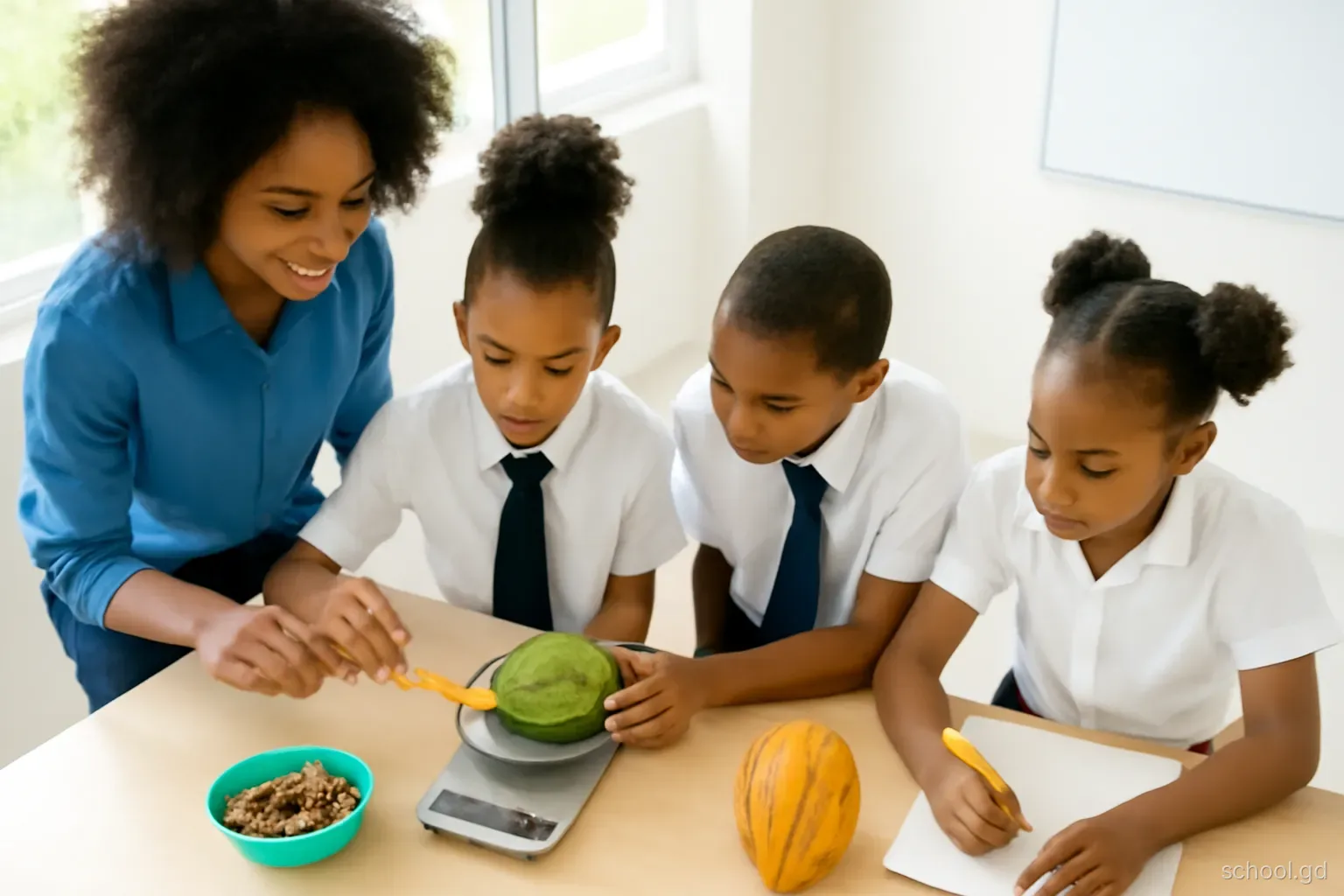
Typical school-based tasks have included a writing portfolio containing several pieces of a child's writing developed over time, a project linking science and social studies, and practical performance tasks in mathematics. The exact components and their weighting are set by CXC and can be revised, so ask the Grade 5 or Grade 6 teacher for the current breakdown.
How the school-based work fits in
It counts. Coursework is not a practice run. It contributes to the final CPEA result, so work done in class across the year matters just as much as performance on the day of the external papers.
It rewards steady effort. Children who struggle under exam pressure can show what they know through extended work, while those who leave everything to the last minute may lose marks they would otherwise earn.
It depends on attendance. Missing large parts of Grade 6, or arriving mid-year from abroad, can mean missing coursework components. Families in that situation should talk to the principal early about how it will be handled.
Parents support, children do. Helping a child plan, find materials and stay organised is appropriate. Writing or polishing the work for them is not, and teachers who know a child's writing will notice.
Records matter. Keep track of deadlines and ask to see feedback on drafts. If something is lost or a child is ill during a key task, raise it with the teacher immediately.
Timing across Grade 5 and Grade 6
In practice, CPEA preparation runs across the last two years of primary school. Teachers begin building skills and introducing coursework in Grade 5 or early Grade 6, depending on the school, and the internal components are completed during Grade 6 according to deadlines set by the Ministry and CXC.
The external papers are taken on dates published in advance, typically in the second half of the school year, at the child's own school or at a designated centre. Schools brief parents on the timetable, what children should bring and the rules on the day, such as arriving early and not bringing phones or unauthorised materials.
Results are usually released after the end of the school year, and families are informed of the child's secondary placement during the summer, in time to prepare for Form 1 in September. Grade 6 graduations generally happen before results are known, which many schools prefer, as it keeps the celebration about the whole of primary school rather than a single score.
Children with documented learning needs, disabilities or medical conditions may be eligible for special arrangements in the external papers, such as extra time, a separate room or a reader. These have to be requested through the school before the deadline, with supporting evidence, so families should raise the matter at the start of Grade 6 rather than in the weeks before the assessment. The same applies to a child with a long-term illness who may miss coursework sessions.
How results are used
CPEA results give a profile of performance across the assessed areas. Alongside parents' stated school preferences, they form a key input into secondary school placement, which the Ministry of Education organises nationally. Other factors, such as where a child lives and the number of places in each school, also come into play.
Results are also meant to help secondary schools understand incoming students: which children need extra support in reading or mathematics, and which are ready for more challenge. This is part of the reason the assessment covers several subjects and skills rather than producing a single number.
Because placement follows its own rules, which are covered in more detail in School.gd's secondary schools section, it is sensible for parents to ask the Grade 6 teacher or district office how preferences are submitted and when, rather than relying on how things worked when they were at school themselves.
Common misunderstandings about the CPEA
Several beliefs carried over from the Common Entrance era cause unnecessary anxiety:
- It is all decided on one day. Not so: coursework completed over the year contributes to the final result.
- Only English and maths count. The CPEA covers science and social studies as well, and assesses skills such as writing and project work.
- A disappointing result ruins a child's future. Every child is placed in a secondary school, and students from all schools go on to succeed at CSEC, college and university.
- More extra lessons always means better results. Rest, reading, steady coursework and confidence matter more than hours of drilling past exam papers late into the evening.
- Results show which primary school is best. Results reflect each school's intake and community as much as its teaching, which is why School.gd does not rank schools by them.
- Children who arrive from abroad cannot be placed. Schools and the Ministry have ways to handle late arrivals; the key is raising it early.
Frequently asked questions
What does CPEA stand for?
CPEA stands for Caribbean Primary Exit Assessment. It is developed by the Caribbean Examinations Council and taken by Grade 6 students in Grenada at the end of primary school. It combines school-based coursework with externally set papers, and its results are used in secondary school placement.
Is the CPEA the same as Common Entrance?
No. Common Entrance was a one-off selection exam focused mainly on English and mathematics. The CPEA covers more subjects and skills, and includes school-based coursework completed over time. It was adopted as Grenada moved towards a secondary place for every child.
What subjects are in the CPEA?
The CPEA focuses on language arts, mathematics, science and social studies, with tasks such as a writing portfolio, projects and mathematics performance tasks completed in school, alongside external papers. CXC sets the exact structure and weighting, so confirm the current details with your child's teacher.
When do Grade 6 students get CPEA results in Grenada?
Results are usually released after the school year ends, during the summer, and families are informed of secondary school placement in time for the September start. The exact dates vary from year to year and are communicated through schools and the Ministry of Education.
Can a child repeat Grade 6 to resit the CPEA?
Repeating Grade 6 is not the normal route, since every child is placed in a secondary school. In exceptional cases, such as long illness or arrival from abroad, the school and Ministry may discuss options. Raise any concern with the principal well before the assessment period.