
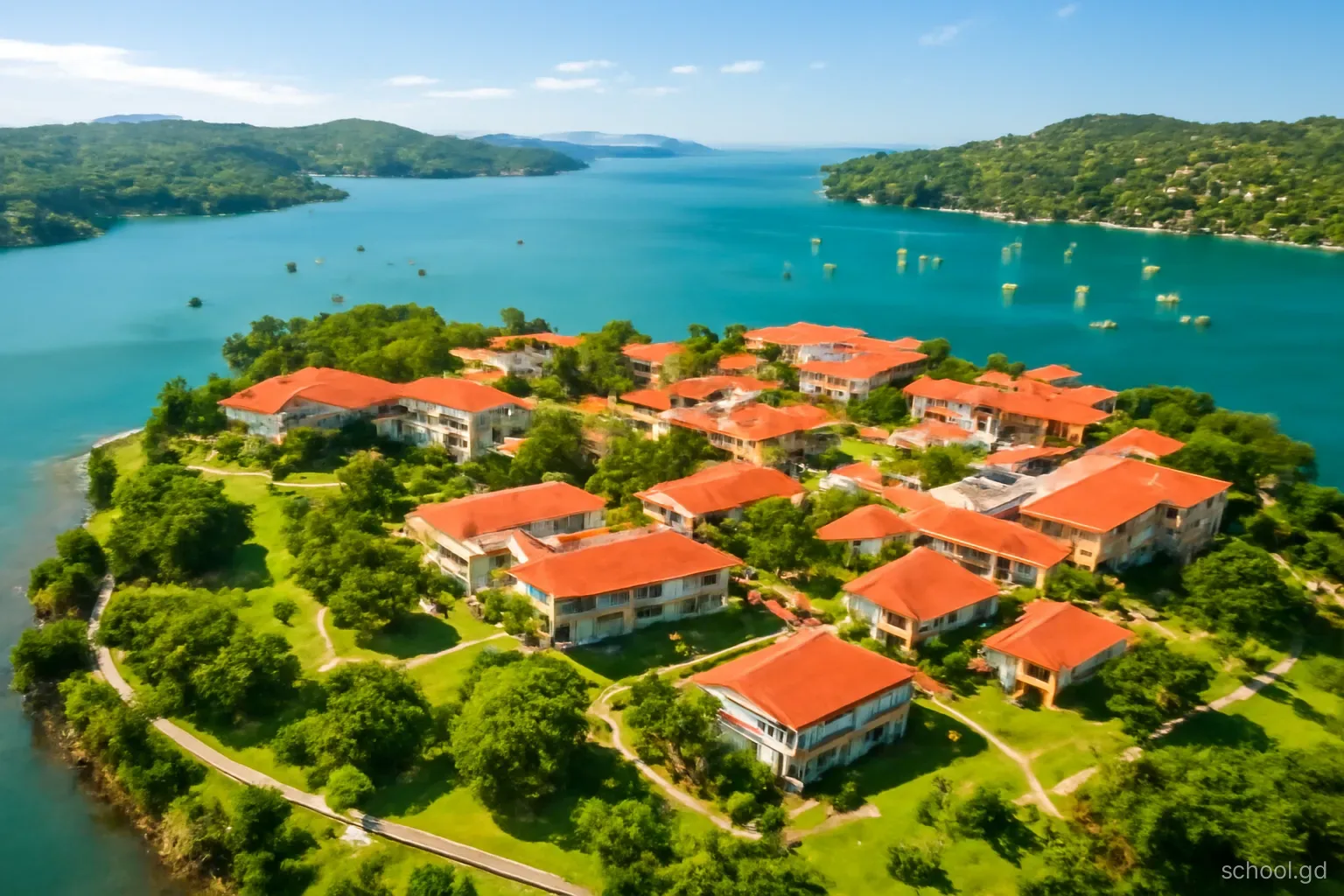
Drive south from St George's towards the airport and, just before the runway, a peninsula of terracotta roofs and manicured lawns slopes down to a sheltered bay. This is True Blue, home of St. George's University, the institution most people outside the Caribbean associate with Grenada after nutmeg and beaches. For thousands of students from North America and beyond, it is where a medical or veterinary career begins.
For Grenadians, SGU is something more complicated and more familiar: an employer, a landlord's best customer, a place cousins study business or nursing, a source of traffic on the airport road, and a thread running through the island's modern history. This profile explains what the university is, how it is organised, and why it matters so much to the country around it.
From a medical school in rented rooms to a full university
St. George's University was chartered in 1976 as a private medical school, and its first students began classes in early 1977. The founding idea was straightforward: to offer a rigorous medical education, recognised in the United States, to qualified students who had not found places in the limited number of North American medical schools. Early teaching took place in modest facilities, including premises in the Grand Anse area.
Over the following decades the university grew in two directions. It expanded the medical programme, building links with hospitals in the United States and the United Kingdom where students complete clinical training. It also broadened into a full university, adding a School of Veterinary Medicine, a School of Arts and Sciences offering undergraduate degrees, and graduate programmes including public health. The True Blue site, developed from the 1980s onwards, became the main campus.
The university's history is bound up with Grenada's. In October 1983, the safety of American medical students at True Blue and Grand Anse was one of the reasons the United States gave for the military intervention that followed the collapse of the People's Revolutionary Government. Grenada marks 25 October as Thanksgiving Day, a public holiday. In 2004 Hurricane Ivan caused severe damage across the island, the campus included, and the rebuilding that followed shaped much of the present campus.
The schools that make up SGU
School of Medicine. The largest and best known part of the university, offering the Doctor of Medicine (MD). Students spend the basic-science years in Grenada, or in some pathways partly in the United Kingdom, before clinical rotations at affiliated hospitals abroad. Dual degrees such as the MD with a Master of Public Health have also been offered.
School of Veterinary Medicine. Established in 1999, it awards the Doctor of Veterinary Medicine (DVM). Students complete pre-clinical years on the island and a final clinical year at affiliated veterinary schools overseas.
School of Arts and Sciences. Offers bachelor's degrees, including pre-medical and pre-veterinary tracks as well as programmes in areas such as business, life sciences and information technology. This is the school most Grenadian students attend.
Graduate programmes. Master's and doctoral programmes, including public health, which draw students from across the Caribbean and further afield. Programme lists change, so check the current offer with the university.
The True Blue campus today
The campus occupies the True Blue peninsula in the parish of St George, a few minutes' drive from Maurice Bishop International Airport and close to Grand Anse and Lance aux Epines. Its buildings, mostly in a consistent style with arcades and red roofs, hold lecture halls, laboratories, a library, student centres, residence halls and administrative offices, arranged around lawns that run down towards the water.
For a visitor, the campus is visually striking but it is a working university, not a tourist site. Access is managed by security, and casual visitors should not expect to wander in. Events open to the public, such as lectures, health fairs or graduation-related activities, are announced by the university.
Much student life happens off campus. Most students live in rented apartments in the surrounding neighbourhoods and travel in by the university's bus service, private car or on foot. The result is a campus that is busy from early morning during term and noticeably quieter during breaks, with the same rhythm reflected in the restaurants, supermarkets and gyms of the south coast.
Research and public health work
SGU hosts the Windward Islands Research and Education Foundation, known as WINDREF, founded in the 1990s as a research institute on campus. It has supported research on tropical and infectious diseases, public health, marine and environmental topics, and One Health questions that link human and animal health, often in partnership with Grenadian ministries and regional bodies.
Students and faculty have also taken part in public health and outreach work in Grenada, from health screenings to research on conditions such as diabetes and hypertension, which are major concerns in the Caribbean. The veterinary school's work touches local animal health, wildlife and marine species.
This side of the university is less visible than the medical programme, but it is part of why SGU is woven into the island's institutions rather than sitting apart from them. Grenadian researchers and health professionals appear among faculty and staff, and collaborations with the Ministry of Health have been a long-running feature.
How the university year shapes the south of the island
Anyone living in the south of Grenada soon learns to read the SGU calendar without looking at it. In the weeks before a new intake, rental signs come down, supermarkets in Grand Anse stock up, and taxi drivers make extra runs to the airport. During exam blocks, restaurants that are normally busy with students go quiet, and study rooms on campus fill late into the night. When terms end, flights out of Maurice Bishop International Airport fill with students heading home, and the airport road is suddenly easier to drive.
Graduation and white coat ceremonies bring visiting families, many of them on their first trip to the Caribbean, who book villas, hire cars and take island tours. That flow of visitors is a steady, if less visible, part of Grenadian tourism, and it does not depend on cruise schedules or winter seasons in the same way as conventional holiday travel.
The same rhythm affects local families. Rents in the student belt track university demand, and Grenadians looking for apartments near Grand Anse often find themselves competing with students. Businesses from laundries and gyms to bakeries and car rental firms plan around term dates, and many Grenadians work in jobs connected to the university, directly or indirectly.
Why SGU matters to Grenada
An economic anchor. With thousands of international students, faculty and visiting families spending money on rent, food, transport and services, SGU is one of the largest contributors to Grenada's economy and among its biggest private employers. Its term calendar shapes demand across the south of the island.
A housing market of its own. Landlords in Lance aux Epines, True Blue, Grand Anse, Calliste and nearby areas build and price apartments with students in mind. That brings investment, and also pressure on rents for local families.
A local university option. For Grenadians, the School of Arts and Sciences offers degree study at home, and scholarships for Grenadian students have long been part of the university's relationship with the country.
A link to the wider world. Graduates practise medicine and veterinary medicine across North America and beyond, and many keep a lasting connection with the island.
A source of debate. As with any large institution in a small country, there are discussions about traffic, environmental impact, housing costs and how benefits are shared. These conversations are part of the relationship, not a sign that it is failing.
Frequently asked questions
When was St. George's University founded?
St. George's University was chartered in 1976 as a medical school, and its first classes began in early 1977. It has since grown to include veterinary medicine, arts and sciences, and graduate programmes, with its main campus at True Blue in the parish of St George.
Where is the SGU campus?
The main campus is on the True Blue peninsula on Grenada's south-west coast, close to Maurice Bishop International Airport and a short drive from Grand Anse and Lance aux Epines. Most students live in rented accommodation in the surrounding neighbourhoods.
Can visitors tour the SGU campus?
The campus is a working university with managed security, so casual visitors should not expect to walk in. Prospective students can arrange visits through the university's admissions office, and some events open to the public are announced by SGU.
Is SGU only a medical school?
No. Medicine is the largest programme, but SGU also has a School of Veterinary Medicine, a School of Arts and Sciences offering bachelor's degrees, and graduate programmes such as public health. Many Grenadian students attend the undergraduate school.
What role did SGU play in the 1983 events?
In October 1983, the United States cited the safety of American medical students at SGU's True Blue and Grand Anse sites as one reason for its military intervention in Grenada. Grenada marks 25 October as Thanksgiving Day, a public holiday.