
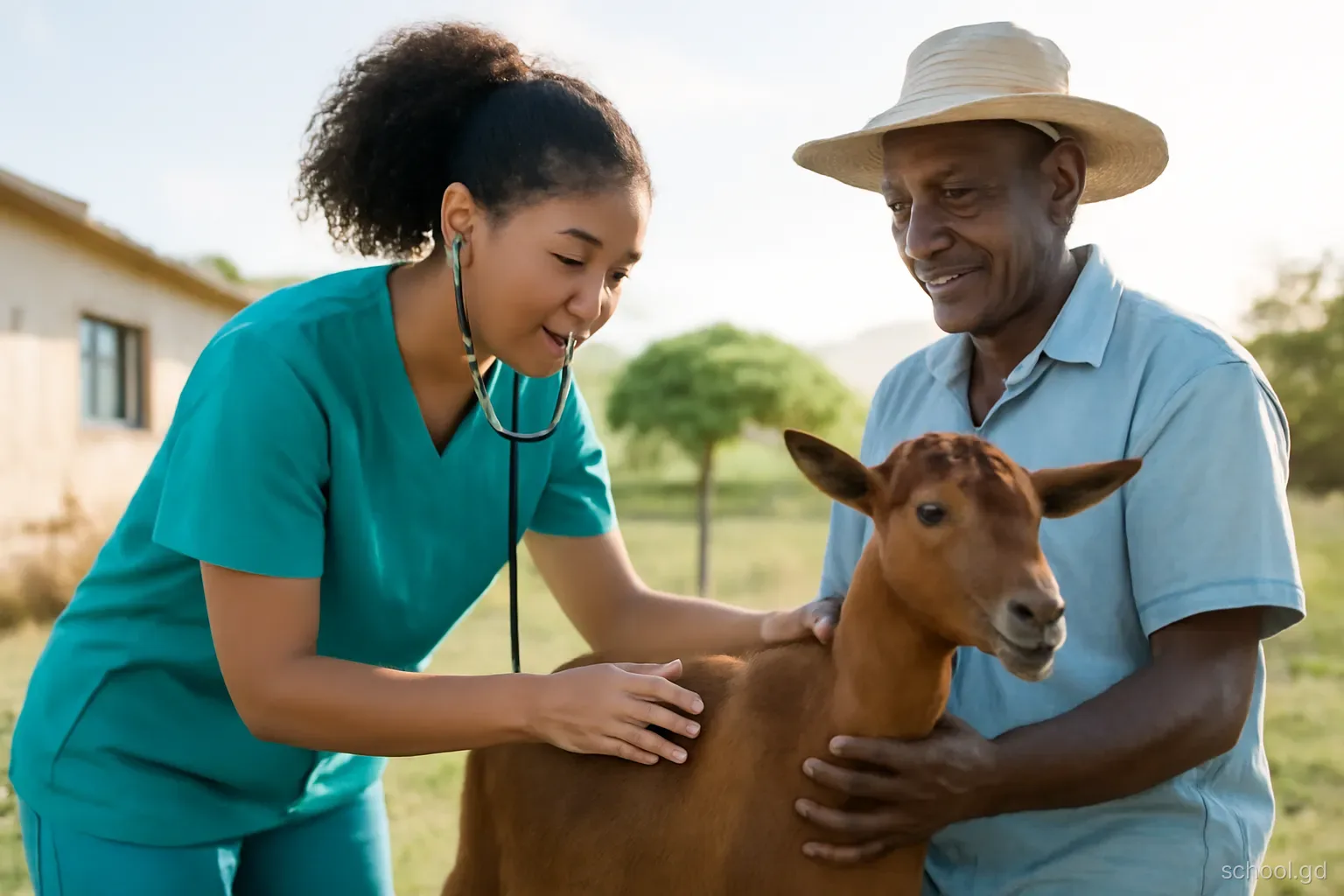
SGU's School of Veterinary Medicine opened in 1999 and has since become one of the better-known routes into veterinary practice for students from North America and elsewhere. Students spend the pre-clinical years in Grenada, working with animals and with the island's farming and wildlife context, and then complete a final clinical year at an affiliated veterinary school abroad.
For a prospective vet student, the programme raises specific questions that the medical programme does not: what animals are there to work with on a small island, how clinical skills are taught, and how a degree earned partly in Grenada is recognised at home. This article works through those questions and the practical realities of life as a vet student on the island.
How the DVM is structured
The SGU DVM is a four-year professional degree. The first three years are taught in Grenada and cover the sciences of veterinary medicine, from anatomy, physiology and pathology through pharmacology, microbiology and parasitology, and then into clinical sciences such as medicine, surgery, anaesthesia, theriogenology and diagnostic imaging. The fourth year is the clinical year, spent at an affiliated veterinary school in the United States, Canada, the United Kingdom, Ireland, Australia or elsewhere, where students rotate through hospital services.
SGU's veterinary programme gained accreditation from the American Veterinary Medical Association Council on Education, the body that accredits veterinary schools for the US system, in 2011. Accreditation matters because it affects the licensing pathway for graduates in the United States and some other countries. Prospective students should confirm the current accreditation status and the licensing requirements of the country or state where they plan to practise.
The school has also offered pre-veterinary preparatory pathways through the School of Arts and Sciences for students who need additional science preparation before entering the professional programme.
Working with animals on a small island
Companion animals. Dogs and cats are the bread and butter of any small-animal practice, and Grenada has plenty, including many street and community animals. Students gain experience in clinical skills, preventive care and surgery through the school's teaching facilities and community programmes.
Farm animals. Grenadian smallholdings keep goats, sheep, cattle, pigs and poultry. These animals give students exposure to production medicine and the realities of small-scale tropical farming, which differs from large commercial systems in North America.
Horses. Grenada has a small horse population compared with larger countries, so equine experience on island is more limited. Students with strong equine interests often build that experience in the clinical year abroad.
Wildlife and marine species. Mona monkeys, introduced centuries ago and found in the island's forests, along with sea turtles, seabirds and marine mammals, give the school opportunities in wildlife and conservation medicine, often in partnership with local organisations.
Public health links. Zoonotic diseases, food safety and vector-borne illnesses connect veterinary work with human health, a One Health focus shared with SGU's research foundation, WINDREF.
Teaching facilities and clinical skills
Pre-clinical teaching at True Blue combines lectures, laboratories and hands-on practical classes. Students learn handling and examination techniques on live animals, practise surgical skills on models and simulators before moving to supervised procedures, and work through cases in small groups. The school has operated teaching facilities for small and large animals on and near campus, and students also take part in community outreach, such as spay and neuter clinics.
Grenada's veterinary sector is small. There are government veterinary services under the Ministry of Agriculture, private practices in and around St George's, and animal welfare groups such as the Grenada Society for the Prevention of Cruelty to Animals. Students can gain perspective from seeing how veterinary care works in a resource-limited setting, where clients may weigh treatment costs carefully and diagnostic equipment is less abundant than in a large North American hospital.
That context can be a strength. Graduates often describe it as having taught them practical, physical examination-based skills and an awareness of cost-conscious medicine that remains useful in any practice.
The clinical year abroad
The fourth year moves students to an affiliated veterinary school, where they join that school's own students on clinical rotations through services such as small-animal medicine and surgery, emergency and critical care, large-animal services, anaesthesia and diagnostic imaging. Placement options depend on the list of affiliates at the time, and preferences are not always guaranteed.
For students, this means planning for a move away from Grenada after three years, with a new city, housing and costs. For those from the United States or Canada, a clinical year at a school in their home region can be helpful for networking and licensing. Others choose placements abroad for the experience or because they intend to practise in that country.
Licensing follows graduation. In the United States and Canada this typically involves the North American Veterinary Licensing Examination and state or provincial requirements. Those intending to practise elsewhere should check the rules of the relevant veterinary regulator well before the clinical year.
Things prospective vet students should weigh
The full cost, including the clinical year. Tuition, living costs in Grenada, travel, health insurance and the costs of a year in another country all add up. Build a four-year budget before committing.
Equine and large-animal goals. Students set on equine or intensive production medicine should ask how the programme provides that experience, given Grenada's animal population, and plan the clinical year accordingly.
Loan access. Eligibility for government student loans depends on nationality and the programmes available in a given year. Check with the university's financial aid office.
Climate and lab work. Working with animals in Grenada's heat and humidity, often outdoors, is physically demanding. Light clothing, hydration and sun protection are part of daily life.
Pets. Students who want to bring a pet to Grenada need to meet the island's import requirements, which involve permits, vaccinations and health certificates issued through the Ministry of Agriculture's veterinary services. Start the process months ahead, and check current rules before travel.
Deciding whether the programme fits
Applicants considering SGU usually compare it with veterinary schools in their home country, where places can be scarce, and with other Caribbean veterinary programmes. The comparison is not only about admission odds. It is about cost, accreditation, the structure of the clinical year, the type of animal experience available, and how comfortable the student will be living on a small island for three years.
Questions worth putting to the admissions office include how clinical-year placements are allocated, which affiliates are currently available, how students gain large-animal and equine experience, what academic support exists for students who struggle in early terms, and how graduates have fared in licensing exams. Asking to speak with current students or recent graduates, ideally ones with similar career goals, gives a more rounded picture than marketing material.
It also helps to visit if possible, or at least to talk through daily life with someone who has lived in Grenada: the heat, the cost of imported goods, the pace of island services and the distance from family. Students who arrive with realistic expectations tend to adapt quickly and make the most of an unusual setting for veterinary training.
Life outside the lab
Vet students share the south-coast housing belt with medical and undergraduate students, so the practicalities of daily life, renting, transport and shopping, are similar. The vet cohort is smaller than the medical one, which tends to create a close-knit student community, with clubs organised around species interests, wildlife and outdoor activities.
Many vet students become involved with animal welfare in Grenada, fostering dogs or cats, volunteering with rescue groups or helping at clinics. That can be rewarding, but it is wise to think carefully before adopting an animal, because taking a pet home at the end of the programme involves the import rules of the destination country and may be costly. Volunteering, fostering through an established organisation or helping with community clinics are often better ways to contribute during a time-limited stay.
Frequently asked questions
Is SGU's veterinary school accredited?
SGU's School of Veterinary Medicine received accreditation from the American Veterinary Medical Association Council on Education in 2011. Accreditation affects licensing routes for graduates. Confirm the current status and the requirements of the country or state where you intend to practise.
How long is the SGU DVM programme?
The DVM is a four-year programme. Students spend the first three years in Grenada on pre-clinical and clinical sciences, and the fourth year at an affiliated veterinary school abroad completing clinical rotations. Pre-veterinary pathways exist for students who need extra preparation.
What animals do SGU vet students work with?
Dogs and cats, farm species such as goats, sheep, cattle, pigs and poultry, and wildlife including mona monkeys and sea turtles. Grenada has relatively few horses, so equine experience on the island is more limited.
Can a student bring a pet to Grenada?
Yes, but pets must meet Grenada's import requirements, which typically involve an import permit, vaccinations, microchipping and health certificates handled through the Ministry of Agriculture's veterinary services. Start planning months ahead and confirm current rules before travelling.
Where is the clinical year completed?
The final year is completed at an affiliated veterinary school, with affiliates in countries including the United States, Canada, the United Kingdom, Ireland and Australia. Placement options depend on current affiliations, and student preferences are not always guaranteed.